
Measure, don’t guess
Compressed air audit
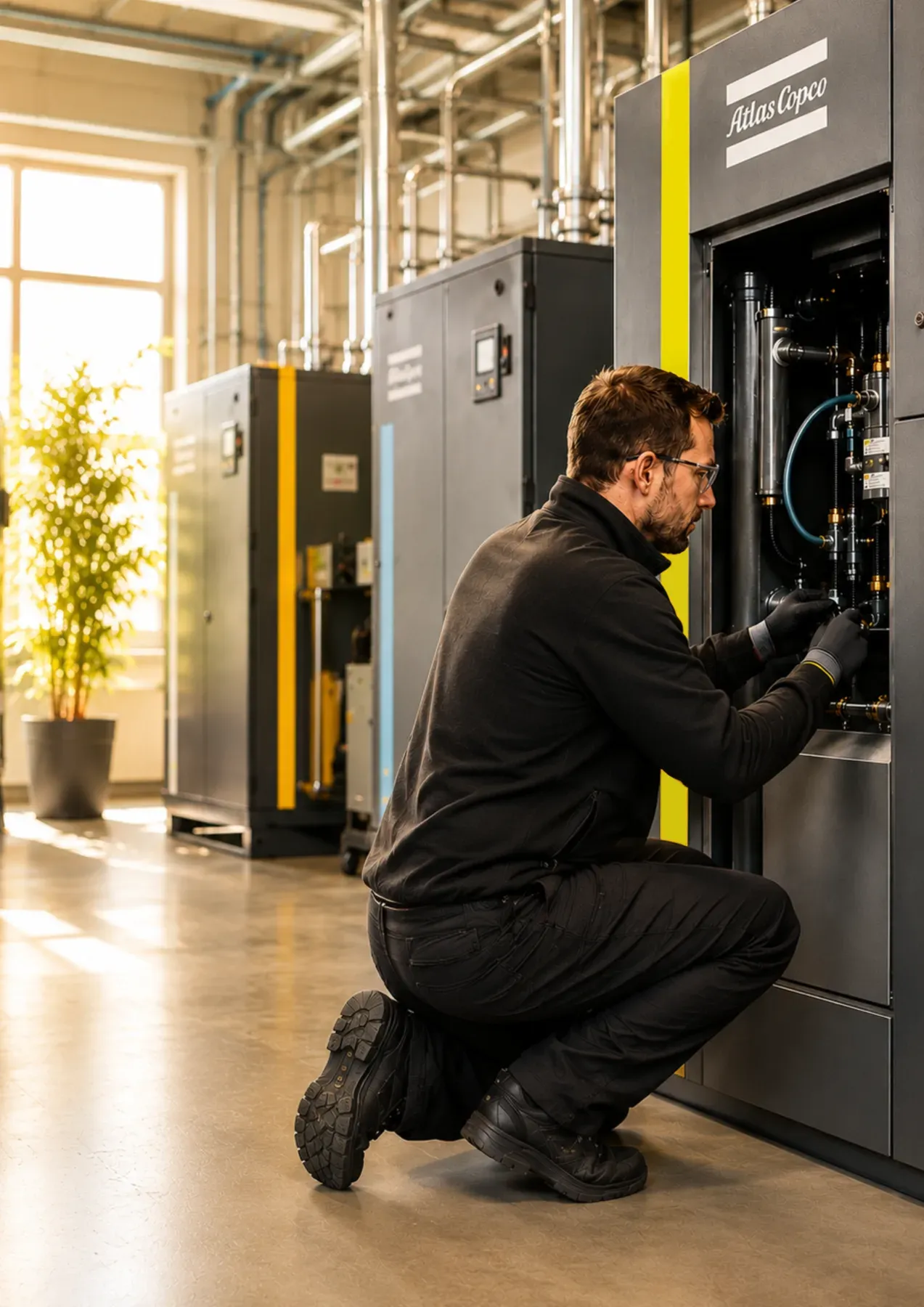
How well is your compressed air system really performing? We find out – with measurements taken directly on your system.
Figures instead of
gut feeling
Whether a compressed air system is running well is hard to judge from the outside. Leaks, fluctuating pressure or contaminated air often only become apparent when costs rise or products suffer.
We come to you with mobile measuring equipment, record quality, consumption and leaks, and summarise the results in a clear, comprehensible report.
Average savings potential: 20–30% of compressed air costs
Where we measure
Three measuring points,
one clear picture
-
Measuring point 01: Leaks
Compressed air often escapes unnoticed at couplings, fittings and hoses. We track down these points using ultrasound.
-
Measuring point 02: Consumption
A flow sensor in the main line downstream of the receiver shows how much compressed air your operation actually uses.
-
Measuring point 03: Quality
At the sampling point after the treatment stage or directly at the point of use, we check the condition in which the air arrives.
Our measurements
What we
measure for you
We measure where compressed air costs money or safeguards quality: every measurement provides reliable figures for targeted, cost-effective improvements.
-
Leaks
Using ultrasonic leak detectors, we inspect your network, even while production is running. Every leak we find is tagged, photographed and recorded in the report together with its savings potential.
- Ultrasound
- On-site tagging
- Photo documentation
- Savings potential
-
Consumption
We record flow and pressure over several days to obtain a load profile of your operation – with peaks, base load and periods without production. This shows whether generation and demand are well matched and how your compressors should be optimally sized.
- Flow rate
- Pressure curve
- Long-term measurement
- Load profile
- Base load
-
Quality
We measure particle, residual oil and moisture levels to ISO 8573-1 and measure the pressure dew point. On request, we also analyse the microbiological contamination of the compressed air to ISO 8573-7. This shows you whether your treatment delivers the required purity and gives you proof of your compressed air class.
- ISO 8573-1
- Particles
- Residual oil
- Moisture
- Pressure dew point
- Microbial count to ISO 8573-7
Additional measuring services
Keeping an eye on
energy and pressure
For a complete efficiency assessment, we measure not only the air and the network but also the performance of your compressed air generation equipment.
More about efficiency consulting-
Power consumption
We measure the energy consumption of your compressors and use it to determine the specific power – in other words, how much electricity each cubic metre of compressed air costs.
Identify savings potential in generation
-
Pressure profile analysis
We record the pressure curve at the generation side and at the points of use, revealing pressure drops, excessive set points and unfavourable switching cycles.
Improve control systems in a targeted way
Your question isn’t listed?
Whether it is the pressure curve on a specific machine, checking the pressure dew point after a dryer replacement or determining the microbial count to ISO 8573-7 for sensitive applications – get in touch. We tailor the measurement to your task.
Process
Four steps
to the result
From your first enquiry to the finished measurement report – this is how a compressed air analysis works with us.
-
Enquiry & consultation
You tell us about your system and your requirements. Together we decide what is to be measured.
-
On-site appointment
We schedule the appointment around your operations and bring the right measuring equipment with us.
-
Measurement & evaluation
We take measurements on your system and then carefully evaluate the recorded data.
-
Report & recommendation
You receive a measurement report with an assessment, specific recommendations for action and an estimate of when the measures will pay for themselves.
Sample report
What your
report looks like
After leak detection, you receive a leak report: every leak found with photos, findings, air loss and annual costs – and, at the end, an evaluation of all leaks.
-
Cover page
Customer details, electricity price, operating hours and the limits of the leak classes.
-
Leak in detail
Location, findings, air loss in m³/h and annual costs – with photos so the leak can be found again quickly.
-
Evaluation
Number of leaks per class, total air loss, energy consumption and electricity costs.
Example – customer data redacted
Why DDZ
What makes
the difference
A measurement pays off when the figures turn into real savings. That is exactly what our work is geared towards.
-
Measured on your system
No estimates from tables: the basis is data we record in your operation under real conditions.
-
Results we explain
We go through the report with you and translate the readings into clear statements and next steps.
-
One dedicated contact
From the first question to the report, you have one person at our company who knows your system and your project.
Good to know
Questions about
measurement
Which standard is used to measure compressed air quality?
The purity classes for particles, water and oil are based on ISO 8573-1. For the microbiological analysis, i.e. determining the microbial count, we use ISO 8573-7.
When does a compressed air measurement make sense?
For example, when electricity costs are rising, a new compressor is being planned, the system is audibly hissing or your production or your customer requires a specific air quality. It is also suitable as a regular check as part of quality management.
How long does a measurement take?
That depends on the task. Leak detection or a quality check is usually completed quickly; for a meaningful load profile we record over several days. We agree the time frame with you in advance.
What does the measurement report contain?
The report contains the measured values, their interpretation and an assessment of your system. For leak detection, the leaks found are listed with a photo and savings potential. Finally, we recommend appropriate measures.
Does production have to stop for the measurement?
As a rule, no. We measure during normal operation, because that is exactly when the actual conditions become visible. If the system briefly needs to be depressurised to install a sensor, we agree this with you.
Can several measurements be combined?
Yes. We often combine consumption measurement, leak detection and quality testing in one appointment. This saves journeys and gives a complete picture of your system.
Which region do you cover?
We work throughout the Ruhr area and also visit companies within a radius of around 250 kilometres of Dortmund.
Druckluftzentrum Dortmund
Ready for
your measurement?
Give us a brief description of your system and what you would like to know. We will get back to you with a proposal for scope and date.
24/7 emergency service: 0800 10 11 821 (free of charge within Germany)
Go to the contact form